
Renders to reality
How Relativity Space use real-life visuals to build a flywheel for future growth
November 24, 2023
When it comes to visualising a value proposition, plenty of space brands rely heavily on 3D renders and artificial visualisations.
But while renders often help to illustrate spectacular visions of future breakthroughs, nothing quite compares to reality.
One player actively embracing the value of real-life brand visuals is Relativity Space.
Real images of the Terran 1 rocket, Aeon R engines and Stargate 3D printer are used extensively across Relativity’s public-facing channels.

But the company’s commitment to authenticity extends way beyond their products and services.
When Relativity launched a VR gallery to mark the launch of Terran 1, it would have been tempting to execute an ultra-creative, abstract vision for their multi-planetary ambition — think Mars-scapes complete with human habitats, 3D printers and Earth-Mars traffic.
Instead, the gallery showcased unique artefacts from the company’s past to celebrate just how far they have come, with items including:

◼ The Starbucks receipt on which the cofounders sketched the initial idea for the company.
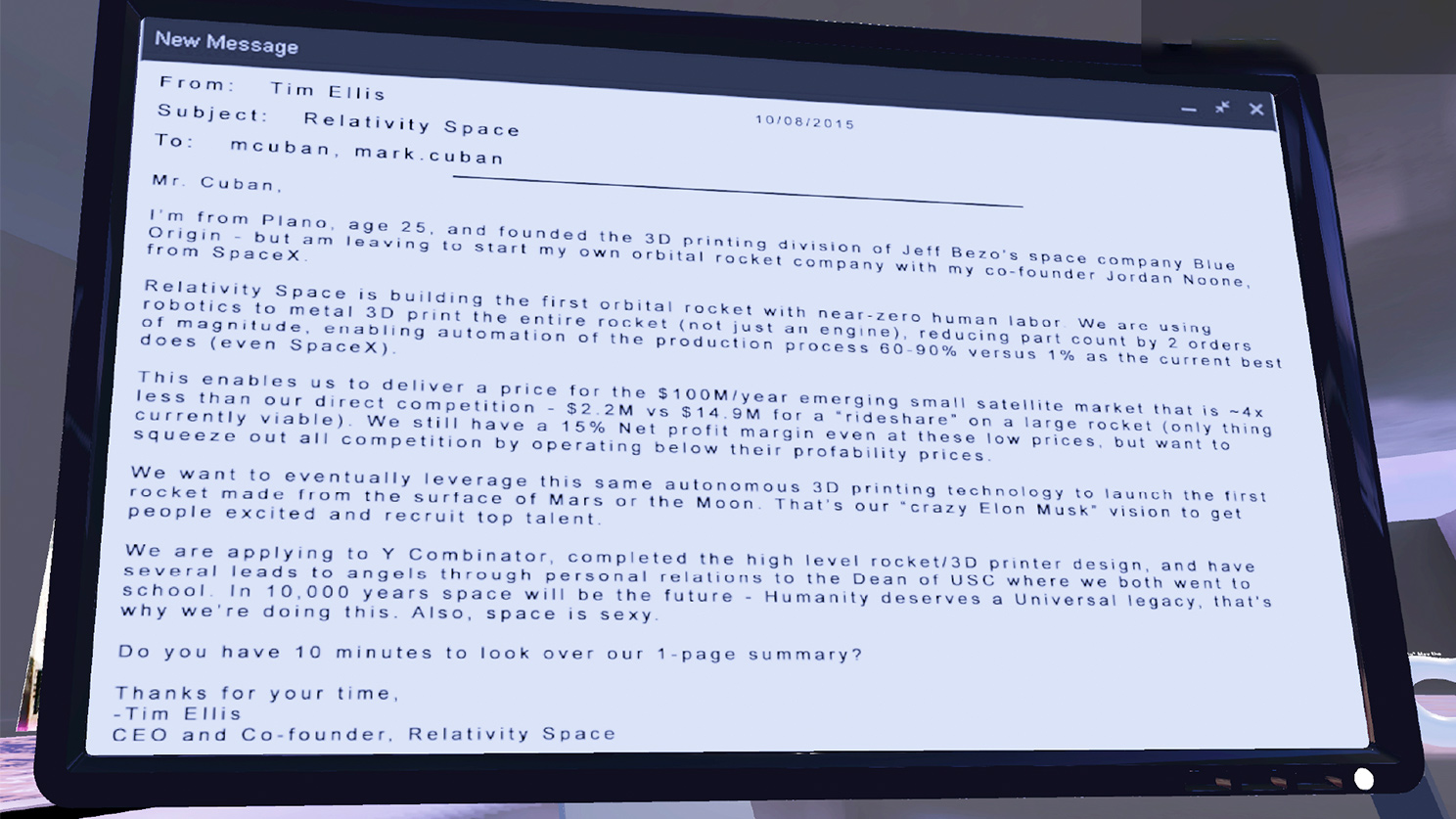
◼ The original cold email pitch that got Relativity their first-ever investment from Mark Cuban.

◼ The very first 3D print that the company ever made.
So why are Relativity actively sharing these artefacts with the public?
As Relativity CEO and Cofounder, Tim Ellis puts it,
“Reality is the most inspiring thing you can do…[talking] about inspiration as a product itself is pretty important because that’s what’s going to get the momentum behind us.“
So while most space brands lean on artificial visualisations to try and inspire audiences, Relativity are strategically building a flywheel for future growth with reality as a fundamental component.

Do Relativity use 3D renders in their public-facing comms? Absolutely. But they intentionally balance them with a healthy dose of real-life milestones through photography, video and VR.
For space brands developing a new product or service, Relativity demonstrates that documenting the journey has significant value when it comes to inspiring people.
As more products and services are built, tested and shipped, space brands have unparalleled opportunities to use real-life visuals to motivate stakeholders and drive momentum.
In an industry as saturated with artificial visualisations as the space sector, a little reality can go a long way.
 Ed Fyfe Design